Here's what's posted on the website and Yahoo group of the Marans Club that is writing the proposed standards - first read General Standards of the Marans and then the Standards for the Black Copper Marans:
Posted by Bev - in July 2010 - the "General Standards"
Proposed APA Standard
Standard of the Marans
Disqualifications:
Yellow on shanks or toes. White ear lobes. Feathers on middle or inner toes.
Standard Weights (approved 6/11/10)
Cock
.
..8 lbs Hen
6 1/2 lbs
Cockerel
.7lbs Pullet
..5 1/2 lbs
ShapeMale (approved 6/11/10)
COMB: Single, moderately large, straight, upright, evenly serrated with five points; the blade not touching the neck.
BEAK: Long, stout and well curved.
FACE: Smooth, skin fine and soft in texture.
EYES: Large and prominent.
WATTLES: Medium in size, oval, skin fine in texture.
EAR-LOBES: Average in size, long.
HEAD: Moderate in size, slightly flattened on top, and long.
NECK: Moderately long and full, arched. Hackle abundant, flowing well over the shoulders.
BACK: Wide at the shoulders, long, flat, slightly tilted to the rear. Slightly more inclined than that of the female.
Saddle feathers -- abundant, saddle large and slightly raised.
TAIL: Full, rather short, carried at an angle of 45 degrees above horizontal.
Main tail feathers -- broad and overlapping, shorter than average.
Sickles -- shorter than average.
WINGS: Short, held close to the body, carriage nearly horizontal.
Primaries and secondaries: broad and overlapping in natural order when wing is folded.
BREAST: Strong, broad, and full. Well rounded when viewed from both the front and side.
BODY AND FLUFF: Body -- deep, long and broad, especially through the shoulders which are carried high. Overall, rectangular in shape.
Fluff -- medium in length.
LEGS and TOES: Legs set well apart and straight when viewed from the front.
Lower thighs -- strong and well feathered.
Shanks -- medium length, stout, and straight; lightly feathered down the outer sides.
Toes -- four long and well-separated toes on each foot. Outer toes lightly feathered, middle toes free from feathers.
PLUMAGE: Moderately tight and smooth textured.
ShapeFemale (approved 7/09/10)
COMB: Single, smaller than that of the male; straight and upright, evenly serrated with five points, and fine in texture. No female in or near production with the rear portion of the comb lopped should be discriminated against.
BEAK: Long, stout and well curved.
FACE: Smooth, skin fine and soft in texture.
EYES: Large and prominent.
WATTLES: Medium in size, oval.
EAR-LOBES: Average in size, long.
HEAD: Moderate in size, slightly flattened on top, and long.
BACK: Wide at the shoulders, long, flat, and slightly tilted to the rear. Slightly less inclined that that of the male.
NECK: Moderately long and full, arched.
TAIL: Full, rather short, carried at an angle of 45 degrees above horizontal.
Main tail feathers -- broad and overlapping, shorter than average.
WINGS: Short, held close to the body, carriage nearly horizontal.
Primaries and secondaries: broad and overlapping in natural order when wing is folded.
BREAST: Strong, broad, and full. Well rounded when viewed from both the front and side.
BODY AND FLUFF: Body -- deep, long and broad, especially through the shoulders which are carried high. Should be more rounded than the male.
Fluff -- medium in length.
LEGS AND TOES: Legs set well apart, straight when viewed from the front.
Lower Thighs -- strong and well feathered.
Shanks -- medium length, stout, and straight; lightly feathered down the outer sides.
Toes -- four long and well-separated toes on each foot. Outer toes lightly feathered, middle toes free from feathers..
PLUMAGE: Moderately tight and smooth textured.
**************************
AND - from their website
http://www.maransusa.org
Draft Color Standard for
Black Copper (Brown Red) Marans
Color of Male
Disqualifications:
Brown triangular wing bay. Golden or Straw colored hackles.
The cock:
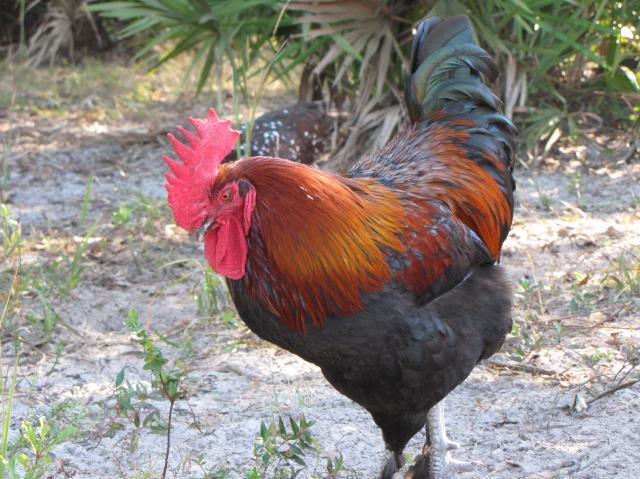
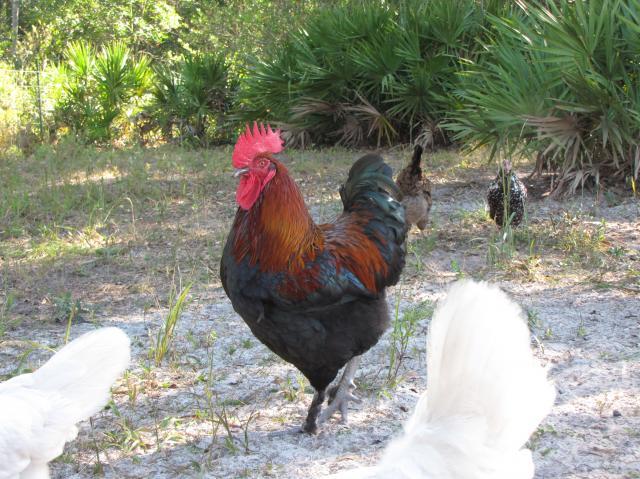
The Ideal specimen will represent a color balance of Black and Copper. The cock must be Black with Copper finery, the hackles and the small of the back are Copper colored, with a Black or slightly reddish-brown marked breast.
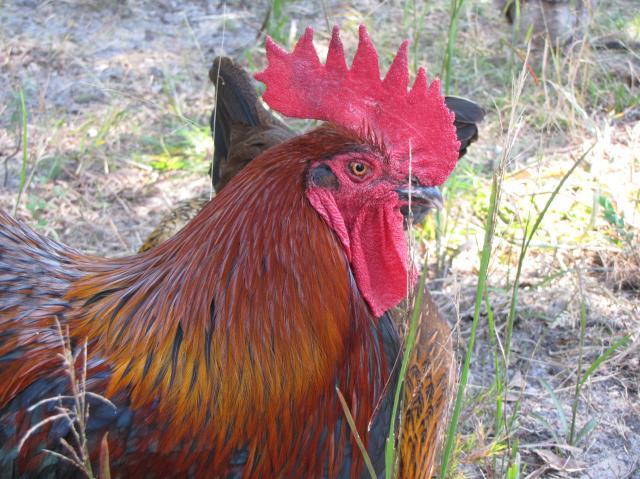
Comb, Face, Wattles and Earlobes: Bright red.
Beak: Dark Horn.
Eyes: Reddish Bay.
Shanks and Toes:
Dark Slate, bottom of feet pinkish white.
Head: Deep Strong Red Copper color.
Neck:
Hackle: Deep Copper color (mid-coppery to red-coppery, but not golden or straw colored).
Front of neck: Black with narrow lacing of Deep Copper.
Back:
Back: Lustrous Deep Copper.
Saddle: Deep Copper color matching the hackle.
Tail:
Main Tail: Black with slight luster.
Sickles and Coverts: Lustrous black with glints of beetle Green.
Wings:
Shoulders: Mahogany Red color.
Bows: Lustrous Deep Copper to match back.
Coverts: Lustrous black forming a black armband.
Primaries: Black.
Secondaries: Black (exposed portion forms a lustrous Black Triangular wing bay).
Breast: Black or with slightly Copper marks.
Body and Stern: Black.
Legs & Lower Thighs: Black.
Shank and Toe Feathering: Black.
Ear Down: Brown.
Color of Female
Disqualifications:
Brown spotting on the body.
The Hen:
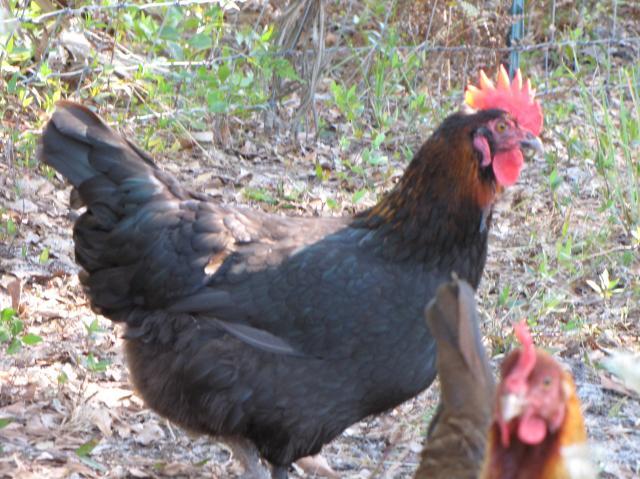
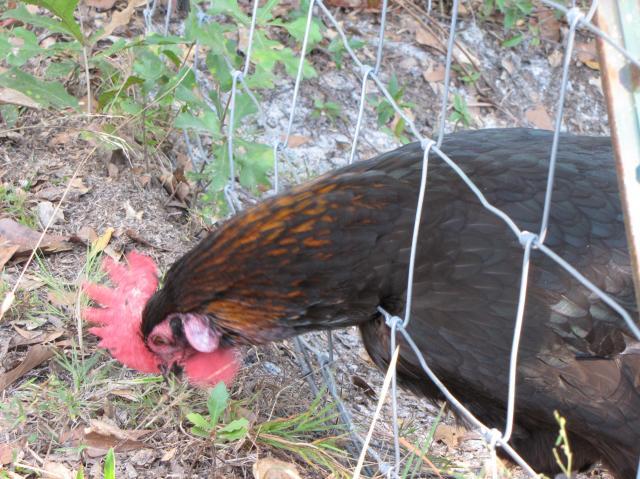
The hen must be black with a copper hackle.
Comb, Face, Wattles and Earlobes: Bright red.
Beak: Dark horn.
Eyes: Reddish bay.
Shanks and Toes: Dark Slate, bottom of feet pinkish white.
Head: Copper (varying from mid-copper to red-copper).
Neck:
Hackle: Copper with a black-colored tip (spreading out almost down to the breast).
Front of neck: Copper.
Back: Black.
Tail: Black.
Wings: Black.
Breast: Black.
Body and Stern: Black.
Legs & Lower Thighs: Black.
Shank and Toe Feathering: Black.
Ear Down: Black.