Naked Neck/Turken Thread

@Kev

I was reading it in a thread here on back yard chickens.

"Anyone Else Breeding for Opal". I think is the thread name.

Thanks and yeah it's the same new mutation color. So far everything I have read/remember points to it being a simple recessive.

as for below... this is from memory from when the Opal was "announced" and interest was high.. then radar seems to have gone silent since then. Maybe it's still discussed in the OEGB circles but that's a breed I simply have no interest in so I don;t wander into those areas at all.

To breed for Opal NN you would have to get opals or opal carriers as it really seems to be a truly a new mutation(although some are saying the same color was present in some European breed, I forget which one). To get the same Opal color, probably best to breed with solid blacks as it appears to alter the black pigment....

I have no idea what opal does over other colors as I have not seen any one crossing it with other colors AND describing or showing pictures of the results. Kind of some talk but not much walk. So I haven't seen any information on how Opal deals with red/gold pigments or other mutant diluters like blue, chocolate etc.

There *may* be some evidence it is a mutation that happens to be at the same location as the recessive white is located at. So avoid breeding with recessive whites otherwise you might get lost as to which chicks are Opal or not. I can't remember if Opal is dominant or recessive to recessive white.

What that means is if you breed a pure Opal or recessive white to a black chicken, you get black chickens because both are recessive genes. However if both opal and rw really are located at the same spot on the chromosomes... it means you potentially get a different result by breeding Opal with rw(and this is proof of them being what's called "alleles"- different gene variations that share the same spot- the human blood ABO being a good example). I can't remember if recessive white is "dominant" over opal or vice versa. It might have been proven or disproven since then, btw so if you see new info I'd love to know of it..
 
Thanks and yeah it's the same new mutation color.  So far everything I have read/remember points to it being a simple recessive. 

as for below...  this is from memory from when the Opal was "announced" and interest was high..  then radar seems to have gone silent since then.  Maybe it's still discussed in the OEGB circles but that's a breed I simply have no interest in so I don;t wander into those areas at all.

To breed for Opal NN you would have to get opals or opal carriers as it really seems to be a truly a new mutation(although some are saying the same color was present in some European breed, I forget which one).  To get the same Opal color, probably best to breed with solid blacks as it appears to alter the black pigment....  

I have no idea what opal does over other colors as I have not seen any one crossing it with other colors AND describing or showing pictures of the results. Kind of some talk but not much walk.  So I haven't seen any information on how Opal deals with red/gold pigments or other mutant diluters like blue, chocolate etc. 

There *may* be some evidence it is a mutation that happens to be at the same location as the recessive white is located at.  So avoid breeding with recessive whites otherwise you might get lost as to which chicks are Opal or not.  I can't remember if Opal is dominant or recessive to recessive white.

What that means is if you breed a pure Opal or recessive white to a black chicken, you get black chickens because both are recessive genes.     However if both opal and rw really are located at the same spot on the chromosomes...  it means you potentially get a different result by breeding Opal with rw(and this is proof of them being what's called "alleles"- different gene variations that share the same spot- the human blood ABO being a good example).  I can't remember if recessive white is "dominant" over opal or vice versa.    It might have been proven or disproven since then, btw so if you see new info I'd love to know of it..


I sure will.
Thing is I'll need to locate a opal and try it out. I'm assuming that opal to black F1 will all be black.
 
@kev
I found another thread called Ginger Reds and Opal.

Copied this cinversation from there:
Ginger Red And Opal Colors?

#1 of 80
8/22/10
Boggy Bottom Bantams
Hi,
Had a man from Switzerland see my Ginger red d'anvers and asked how to create them as I could not ship to him overseas.
Well these are one of the odd ball d'anver colors I actually bought. So my question is...
What colors and formula of breeding does he need to follow in order to make his owe as they dont have them in any breed for out crossing there?
Also, he send me a pic of what he called an "opal OEGB"
To me, it looks like a silver pyle, colored just like the red pyle, but silver/grey instead of the red, all other body color is white...anyway, told him I'd post here and he asked about that one too while I was at it.

Any tips I could pass along to him, he would appreciate it.
I'm curious about that opal myself, it was gorgeous!

#2 of 80
8/22/10
Chris09
Boggy,
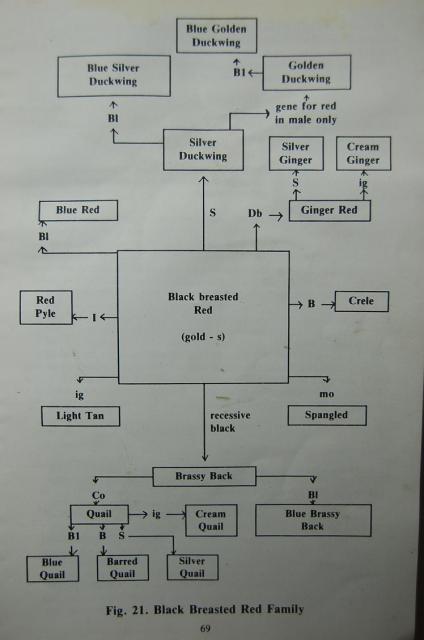
Ginger Red should be Black Breasted Red with Db added. (I believe Db is Dark Brown)

https://www.backyardchickens.com/forum/uploads/33115_dsc_0010.jpg

Chris

#3 of 80
8/22/10
Choctaw Valley Farm
Hey Aubrey, If you would like some of the Opal Old English let me know I sold all my breeders but I think Gwen may still have some, if not I can see how much the people I sold my breeders to would sell me a pair for. I will also see if I can find pictures of our breeders and post them here. The Opal almost looks like a Self Blue except that the Opal's do not always breed true you can get Opal, Blue and Black out a breeding.


Steve

Aubrey, Your website isn't working.

#4 of 80
8/23/10
Boggy Bottom Bantams
Quote:
Originally Posted by Cherokee Trail Farm
Hey Aubrey, If you would like some of the Opal Old English let me know I sold all my breeders but I think Gwen may still have some, if not I can see how much the people I sold my breeders to would sell me a pair for. I will also see if I can find pictures of our breeders and post them here. The Opal almost looks like a Self Blue except that the Opal's do not always breed true you can get Opal, Blue and Black out a breeding.


Steve

Aubrey, Your website isn't working.

yes do that Steve if you dont mind, I'd like to have some...
just checked the site, It came right up?? May have had a server problem or something??

Thanks

#5 of 80
8/23/10
Boggy Bottom Bantams
Quote:
Originally Posted by Chris09
Boggy,
Ginger Red should be Black Breasted Red with Db added. (I believe Db is Dark Brown)

https://www.backyardchickens.com/forum/uploads/33115_dsc_0010.jpg

Chris

Thanks Chris,
I told hin I was near 100% sure they started with bb red, but wasnt sure what else. I'll pass that along to him

#6 of 80
5/30/11
opal oe
Opal Breeds 100% true when Opal is bred to Opal. Opal is a simple recissive

#7 of 80
5/30/11
gumbii
Quote:
Originally Posted by opal oe
Opal Breeds 100% true when Opal is bred to Opal. Opal is a simple recissive

i understand, but what gene is opal..? i heard it came from blacks... that wouldn't make sense unless there was another gene involved... i thought they were like a sport/splash for self blue... crazy... no calculator has an opal option or gene...

#8 of 80
5/31/11
Boggy Bottom Bantams
Quote:
Originally Posted by gumbii
Quote:
Originally Posted by opal oe
Opal Breeds 100% true when Opal is bred to Opal. Opal is a simple recissive

i understand, but what gene is opal..? i heard it came from blacks... that wouldn't make sense unless there was another gene involved... i thought they were like a sport/splash for self blue... crazy... no calculator has an opal option or gene...

yes, that's the same think I've been trying to figure out too gumbii
what makes it gene wise? I have since found some folks with them, but no one yet has been able to tell me how to go about breeding my own, which is my goal.
Only thing I have found on them seems like they are just a mutation color off breeding black to black??

#9 of 80
5/31/11
GotGame
Opal is a mystery, the color appeared when 2 black Old English of unknown origin produced some chicks. Opals are dun based, and that would make it a recessive. Contact Sjarvis on the OKIE thread, he is breeding them and very successfully I may add, and he is NOT crossing every color under the sun with the opals, his are breeding true. Most people i Have talked to with opals are having trouble with off colored chicks hatching, as opals have had all kinds of other colors crossed into them....

#10 of 80
5/31/11
sjarvis00
Quote:
Originally Posted by Boggy Bottom Bantams
Quote:
Originally Posted by gumbii
i understand, but what gene is opal..? i heard it came from blacks... that wouldn't make sense unless there was another gene involved... i thought they were like a sport/splash for self blue... crazy... no calculator has an opal option or gene...

yes, that's the same think I've been trying to figure out too gumbii
what makes it gene wise? I have since found some folks with them, but no one yet has been able to tell me how to go about breeding my own, which is my goal.
Only thing I have found on them seems like they are just a mutation color off breeding black to black??

The Opal did originate from a "Black" bird. in the current form in OE here in the US. the color itself has appeared several times before and has been documented by genetic researchers as early as 1986 in the US once again from "Black" OE. When investigated very closely the "black" oe were typically found to be the result of a cross a generation or two back with Lavender. Most serious breeders were culling these chicks at hatch one poultry enthusiast had a genetic guru friend who asked for a few to raise out himself back in teh early 80's and documented the color.

The color has since appeared in europe in the Vorwerk from a Lavender (self blue) and from Porcelian which is lavender in base as well.

The color itself appears to be a mutation and can breed true, the current thought on the color is that it is a mutated form of dominant white however without a "pure" specimen being sent out for geneotyping the answer may never really exist.

If you are looking for some to play with I do have a young pair (15 weeks of age) available that have had no outcrosses in several generations and no breeding anomolies or odd chick color, down color variations, leg and eye color are all stabilized.
If you are looking for a very good OE typed bird with good color I will have a few this fall, they are the result of a cross with recessive white three generations back then breed for type and selected for color as well. these are the F4 birds and are looking much better and getting back to good color this year as well, I epect next years to be even better.
 
Last edited:
Here are a few pics of some of the chickens, these are mostly to show size between the NN and the cross girls.


These two are the same age.


I have 4 cross girls, 2 bigger 2 smaller, this is one of each.


I love this ones face


This cross girl is the same age as the smaller nn


Same here, except Beautimous the one w/ the blurred head, she is older by 1.5 months or so


This pose was to cute not to post.
 
Here are a few pics of some of the chickens, these are mostly to show size between the NN and the cross girls. These two are the same age. I have 4 cross girls, 2 bigger 2 smaller, this is one of each. I love this ones face This cross girl is the same age as the smaller nn Same here, except Beautimous the one w/ the blurred head, she is older by 1.5 months or so This pose was to cute not to post.
I love this barred/mottled combination with these whites. And these xs don't look fat at all. Actually they look really good. Oh and does that bearded barred mottled girl has a bit of fm or am I just imagioning?
 
I love this barred/mottled combination with these whites. And these xs don't look fat at all. Actually they look really good.

Oh and does that bearded barred mottled girl has a bit of fm or am I just imagioning?
Yes she does, but doesn't express much and has been lightening.
 
I don;'t agree with the way they are introduced is ever the problem. Except maybe roosters who hold grudges against hens who dare challenge him at introduction. But a good rooster gets over that quickly and welcomes them once they 'submit'.

Some roosters are very mean to hens that are not breeding- attacking broody hens, not in lay hens etc.

Some roosters just don't like particular colors, traits- like crest, comb type etc. This is usually partly an issue of not growing with birds with those colors/traits. Example if a rooster never saw a white hen his whole life, it is possible he will be hostile to them.

Sometimes it seems to be a body type issue- some roosters used to standard size or small hens may attack if a cornish cross hen is introduced. I had that happen with one rooster..... another rooster happily bred her... both of them never saw a white bird or a huge meat type chicken before this hen.

I had 3 bcm and 2 dark brown NNs together. when I brought a salmon faverolles and a black sex link pullets one of the bcm cockerels immediately attacked the poor faverolles. I ran to by other pullets, 1 almost all white and 2 buff/light brown so they got used to different colours. the crazy cockerel didn't bother with the black sex link at all.
 

This pose was to cute not to post.

LOVE this photo! He looks like a muscle guy posing for the ladies.
wink.png
 

New posts New threads Active threads

Back
Top Bottom