Quote:
To answer your questions:
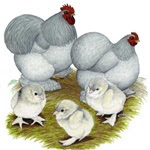
1) You will never get me to use the "L" word to describe this variety. The variety is Self-Blue. It's been a recognized variety by both the APA and ABA for years. Simply put, Self-Blue bred to Self-Blue produces 100% Self-Blue, hense the variety name "Self-Blue."
2) Self Blue is based on the "Lav" genetics, whereas Blue, which is a darker slate base color, is diluted Black.
3) I started this thread for Self-Blue Cochins, which do not exist in any quality in the U.S. to provide updates as far as my progress in improving the type and color. Others have participated in the thread, and used the "L" word.
4) I can't tell you what you will get from your possible Splash Orpington Hen bred to a Black for sure, but if she is indeed a Splash, then bred to a Black you should get 100% Blues. Not Self-Blues, but regular Blues. These will be of varying shade because of the dilution of Black, introduced with the Splash. Blue and Self-Blue have totally different color descriptions per the Standard of Perfection. If you don't have a Standard, I'd recommend purchasing one. It's 100% required if you are interesting in breeding any variety to the Standard.
5) For your proposed Self-Blue Orpington X Self-Blue Orpington breeding. As long as they are indeed Self-Blues, then you will get 100% Self-Blues.
(6) Self-Blue bred to Black = 100% Black offspring, but they are splits. So Self-Blue split to Black. You could take these back to each other in the f2, in which case you'd get 25% Self-Blues, or back to Self-Blues, in which case you'd get 50% Self-Blues in the f2 generation.
Then the way I understand you is that there is no "lavender" just "self blues" and my "lavender orps and lav Ameraucanas are really "self blues" calling themselves "lavenders". I was under the impression that "lavender" was a new thing, but apparently I'm wrong. As for the ABA and APA I'm not all that concerned with Cochins since it's much to wet here for me to deal with them. I was just concerned with the color description.
I did see mentioned the genetics and all that. The ALBC has a nice description of what constitutes an animal being what it is called. I haven't a copy on hand but you can look it up. Short version the way I understand it. If two animals of a breed produce offspring that also are to the breed and so on and so on then it can be assumed that the genetic material is there to produce the breed. To standard of course.
I do wish you the best in your breeding and all that, but like I said I was just concerned about the confusion between "blue" and "lavender". I'm really interested and working with Delawares and Lord have mercy that is a different kettle of fish altogether.
Rancher





 BYC's 52-Week Photography Challenge — Week 12: Details! — Mar 23–29, 2026


