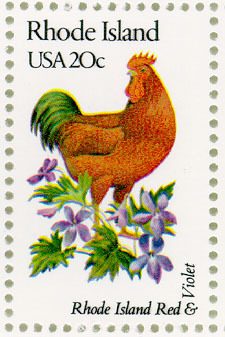
Information below from varies R.I. Red sites and Books
The Rhode Island Reds origin can be dated back to the middle 1840s and one of the oldest breed of chicken to be developed in America.
The States of Rhode Island and Massachusetts should get the most credit for the development of the
Rhode Island Red breed. Poultry farmers in the area wanted a breed of hen that would produce a good amount of eggs a year and still dress out nice as a meat breed.
Breeds that make up the R.I. Red are the Chittagong (Light Brahma Brahmas), Red Shanghai (Cochin), Black Breasted Malay and the Red Malay.
Historians believe that a man by the name Captain Richard Wheatland that lived in Rhode Island around 1846 is the person responsible for the rich red color of the Rhode Island Red we see today.
The early Rhode Island Red sported three types of combs, two of which we still have today.
The first is the Pea comb that may owe its pea comb to the Chittagong, second the Single comb that got its comb from the Cochin and the third is the Rose comb that received its combed from the Shanghai.
In 1954 the governor of Rhode Island signed into law that the Rhode Island Red chicken would be the state bird of Rhode Island.
Information below from The Rhode Island Chronicles.
The Rhode Island Red color pattern is a modified Columbian color pattern that may have came from the Brahma blood that was used in the making of this breed.
The first modification to the Columbian color pattern in the development of the Rhode Island Red was to replace the white with red. Note that in the American Standard of Perfection, it says any bird with a entirely white feather showing in the surface is a disqualification. The second modification was to remove the black pigmentation from all but the wing and tail in the male; and the same for the female with some black ticking remaining at the base of her hackles almost like a necklace. At the end what we have is a Rhode Island Red that has become entirely a rich red with black pigmentation left only in the tail and on one side of the wing feathers and some black ticking remaining at the base of the hens hackles.
Chris