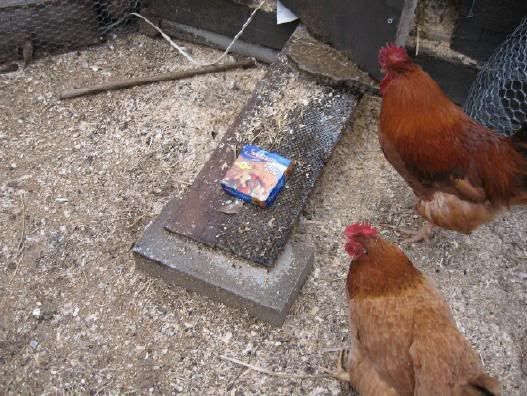
Our chicken `lab' is in Cent. MO., so your mileage will vary:
This is our third winter with chooks and turks.
What we've observed here is that the combination of moisture, produced by chicken respiration, evaporation from the heated water bowl, and inadequate venting of this `fog', led to our problem (ointment and/or temp were the supporting cast).
Chicken Coop is sealed up 6'x7'x8' wood framed, .5" plywood sided affair that was, a long time ago, our daughter's `tree' house. It has NO drafts, but has adjustable venting (in/out) on east wall (after frostbite episodes resulted in improvements). There is a large, heated dog waterer in the coop, as well as a hooded light fixture fitted with a 25W bulb; not much heat to speak of but fixture it is bolted to the rafters and aimed at the ceiling in order to improve circulation of air and give `em a bit of light on the mornings when I have to dig my way to coop (not often). There is a temp/humid. monitor in coop and same model outside hanging on fence (can check both from our kitchen). We also have tarps on the north/west sides of run fencing (prevailing wind).
The first winter we used 125W heat lamp in coop on the coldest nights (-5° - -10°F). This was the only winter the roo, and the hens with larger combs, suffered from frostbite. We had read about the pros and cons of using vaseline (some folks experience was that any oil based substance promoted radiation of heat away from the comb/wattles more rapidly than the tissue would lose using nothing at all). Petroleum/other oil based ointments do decrease `chapping' , and the act of massaging the stuff onto the combs and wattles does improve circulation (used A&D/Bag Balm/etc., on different occasions, i.e., `agghhh! Whats in the medicine cabinet!??!'). The roo would trance when the goop was being applied, but would turn up with more whitish discolorations, that would soon go black, the next morning.
The factors that seem to prevent frostbite are careful attention to coop circulation (proper venting/keeping the humidity level as low as possible - within a few percentage ponts of outside level), and protection from the wind when they are outside.
The temp. dropped, throughout the day, last Sunday, from the mid-30's around 3p.m. to 3.8°, with winds 10-30mph, at 4a.m.. The temp in the coop dropped to 12° and the humidity dropped to match the outside level (40%-50%). On Monday the wind continued to blow (wind chills appreciably
below zero) and the air temp. never hit 20° The chooks hung out in the northwest corner of their run, behind the tarps, all day. I'm rather bemused by this behavior as the lightest fall of nearly invisible snow pellets will send them scrambling for their coop (won't see them again until the last little patch has melted away). Not even the slightest `blackening' of comb points/tips on the roo or his ladies (no emollients or pungent `ungents' required or applied).
To go very low tech on the venting in a nicely sealed up coop: Cut a hole, low, in the east wall (diam. can be increased later so start at about an inch) just above the highest level the bedding comes to along inside wall.
Cover this lower opening with hardware cloth on the inside of the coop.
Drill a scond hole just above the vent hole (the diameter of whatever bolt you have handy that you have a wing nut for).
Fit a washer on the bolt, slide the bolt through the hole from the inside of the coop, glue the washer/bolt head to the inside wall.
Take the lid from a large can of peaches (or whatever) and glue a thin - rubber drain cover/section cut from silcone? cooking sheet - to one side of the lid.
The diameter of the `rubber' `circle' - gasket - should be about .25" greater than the lid itself (extending beyond the edge of the lid far enough to avoid edge of lid when making adjustments, and to insure a good seal when the lid is bolted to wall on the outside of the coop).
Punch/drill a hole through your new `gasket', near the edge, and slip the lid over the bolt. Fit a washer and the wing nut on the bolt and tighten down the wing nut so the lid/gasket fits snugly against the outside of the wall and over the vent hole (vent is then ready to use).
Repeat this process for the upper vent (as high as is possible to easily reach on east wall).
Wing nuts can then be loosened, `lids' (insulated, self-sealing vent covers) shifted to `open' /`close' vents to your specs, and wing nuts tightened down to hold the `vent covers' in place.
This will create an infinitely adjustable venting system that introduces no drafts and can be quickly and easily configured (increase or decrease circulation to whatever degree you determine best by opening/closing upper/lower vents with the twist of a couple of wing nuts). Battery operated temp/humid devices, to test your setup, are bargain bin items these days.
This is a simple, nearly free, method of decreasing probablity of frostbite (no $$$ on heat lamps) and a means of avoiding chooks made grouchy by light pollution.
Of course, palliative measures, i.e., `rooster caps' (little knitted `hoods' over combs, buttoned under the wattles) might become as popular as chicken diapers... Just don't expect to market them on a `family friendly' forum as a
sock... (who do you think you are? Eldridge Cleaver?
)
Roodawg says: "it could be worse..." (12/10/06: making repairs after ice storm - next day 2ft. snow, `Swanson' chooks, yep - but no frostbite)