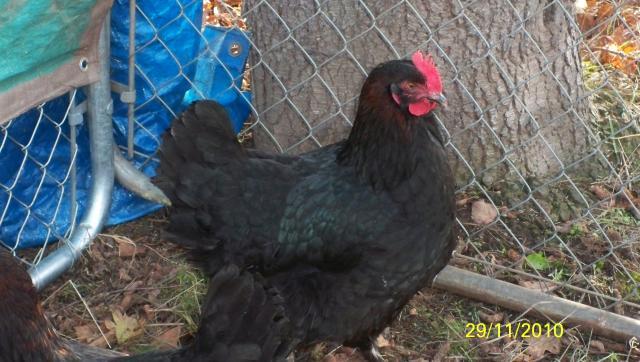
Black Copper Marans discussion thread

I didn't know that the SOP had changed either, but I haven't been watching either. Does anyone know WHEN the final decision will be made so we can move forward?

That is one of the many pleasures of this breed, creating-always striving to perfect and make that perfect bird by whatever means necessary. I love seeing what is coming from my breedings and I never fail to be surprised.
 
Quote:
I have been told by reliable sources that the standard the MCCUSA submitted to APA as final draft will have very few if any changes if they are approved next month at Newnan. Don
 
Hello all. Thanks Geebs for a good thread for us detail geeks. Just read through it all and am trying to remember all my ???'s
Some questions:

In your experience is there a strong correlation between melanization and eye color? Why don't all those copperless BC hens have black eyes?

Shanks: Do U.S. BCM not carry the ID gene that lightens shanks? On Wheaten and Cuckoo it's redundant, but it creates the pale shanks on well melanized birds.
I like the look of pale shanks with dark feathers. They are standard in the French unless they changed it. Not dark slate.
Birds with ID will show a marked difference in sexes. It's a sex linked gene and roos get a double dose = lighter shanks than hatchmate hens.
... is the talk here about white legs the skin or the feathers? I'm pretty sure I've seen lots of pictures of folks with pale shanked BC's, some with good coppering, so some lines must have the ID gene. Why does the U.S. SOP eliminate it?

Ear Coverts: Do roosters with brown vs. copper coverts consistently throw overmelanized hens? I thought as long as they weren't black it was not a red flag.

Consistent Hackle/Saddle color: Is the sole explanation for hackle that is markedly lighter than the saddle that it's a Wheaten cross? Or are there genes involved besides eWh? What kind of hens does a lighter hackled dark saddled rooster throw?

Crossing lines: Many folks say crossing lines dilutes egg color. Is this a 100% rule? Are we talking like from a 5 to a 3 or 7 to a 4? Anyone have something more concrete? Do you get a 100% recovery of color when crossing back to one of the pure parent lines?

I have two roos I'd like to post pics of. How old should they be to make a decent evaluation?

Anyone please feel free to comment on any one single question of mine, you don't have to address them all to reply. Thanks!

 
Quote:
I have been told by reliable sources that the standard the MCCUSA submitted to APA as final draft will have very few if any changes if they are approved next month at Newnan. Don

Excellent! Thank you
 
Villagechicken.. I don't understand why they would eliminate it.. but yes the legs are pink with slate over the top whereas the French basically use the term clear... see through and that makes the shank even lighter yet as we are accepting the slate over the pink. The melaniser is what is black is... too much and the eyes are black and the bird loses the appearance of color in the saddle hackle etc... That is why the french go into great detail about the flecking in the breast and they also talk about why hens presentation is so different from the males etc. I am sure there is a reason I just don't know what it is yet..I am waiting on an answer as we speak...

thanks for your post..

Ppl please post pictures of your birds... I will continue to critique using both my understanding of the french as well as what the standard says for today's date... We love our flocks flaws and all.. Thanks for those of you that have already posted.
 
Boy, I have a lot of catching up to do. . . .
big_smile.png


Quick question - Experienced breeders, how much success do you have in getting coppery females out of a breeding of black females and a male with some excess coppering on the chest? And, how much difference would it make if the females had coppering, but very little, or on the throat instead of the hackle?
 
Illia: I have had good success using darker females on Charles who as a youngster has just a hair too much color in the breast... I posted a pullet last spring, may remember.... I called her my fave and I got really good results, though Don was less than impressed by the amount of copper, however it is important to remember that a small degree at a time allows for more than one generation to be bred back to the same rooster otherwise your balance will get out of whack too quickly.... I just don't know about the under the jaw thing.. All I can say it do it and record the results and please share!!! With charles I have to use hens that are darker red and with more than the desired amount of melaniser to get a good result.. I don't think I can pull off 8 generations without swingng the pendulum to far to the otherside.


16367_october_pictures_211.jpg
 
Last edited:
Wow... I had to catch up on 7 pages of posts and pictures... I'll be getting some pics today, too, hopefully.
smile.png


I have to admit with mine, they are tagged, but I think I have birds from 4-5 different breeders in my pen, plus F1 birds from that pen. I don't think I can honestly say that they are from anyone's lines anymore.
tongue.png
Lucky for me most people just want dark eggs, and aren't after breeding for show. Most of my "culls" wind up in small backyard flocks for eggs with the exception of a couple of other people that I know are trying to improve their flocks. Next generation coming out of the incubator in a few weeks, so we'll see what we get.
smile.png


I do hope that the discussions will stay polite.
wink.png
 
Quote:
Wynette, Legs look correct to my eyes. Would like a little larger picture so we can see the whole package. Don
 

New posts New threads Active threads

Back
Top Bottom