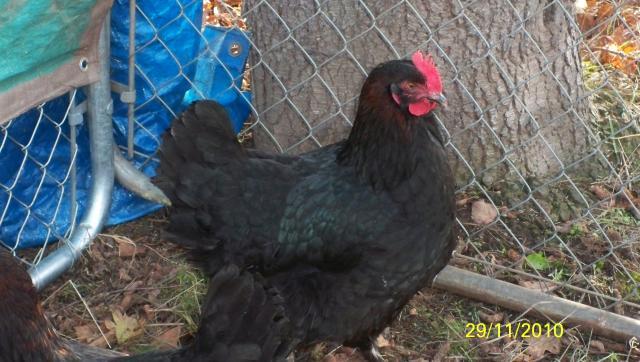
Hello all. Thanks Geebs for a good thread for us detail geeks. Just read through it all and am trying to remember all my ???'s
Some questions:
In your experience is there a strong correlation between melanization and eye color? Why don't all those copperless BC hens have black eyes?
Shanks: Do U.S. BCM not carry the ID gene that lightens shanks? On Wheaten and Cuckoo it's redundant, but it creates the pale shanks on well melanized birds.
I like the look of pale shanks with dark feathers. They are standard in the French unless they changed it. Not dark slate.
Birds with ID will show a marked difference in sexes. It's a sex linked gene and roos get a double dose = lighter shanks than hatchmate hens.
... is the talk here about white legs the skin or the feathers? I'm pretty sure I've seen lots of pictures of folks with pale shanked BC's, some with good coppering, so some lines must have the ID gene. Why does the U.S. SOP eliminate it?
Ear Coverts: Do roosters with brown vs. copper coverts consistently throw overmelanized hens? I thought as long as they weren't black it was not a red flag.
Consistent Hackle/Saddle color: Is the sole explanation for hackle that is markedly lighter than the saddle that it's a Wheaten cross? Or are there genes involved besides eWh? What kind of hens does a lighter hackled dark saddled rooster throw?
Crossing lines: Many folks say crossing lines dilutes egg color. Is this a 100% rule? Are we talking like from a 5 to a 3 or 7 to a 4? Anyone have something more concrete? Do you get a 100% recovery of color when crossing back to one of the pure parent lines?
I have two roos I'd like to post pics of. How old should they be to make a decent evaluation?
Anyone please feel free to comment on any one single question of mine, you don't have to address them all to reply. Thanks!