In a nutshell, the leg feathering is very complicated. There's not just "one gene" involved in leg feathering.
It's like the E allele, where there are multiple mutations that have occurred - for example on the wild type e+ allele, we have ER birchen, or eWh wheaten, or E extended black.
So it's not like the Blue gene, where you either have Bl (blue) or bl (not blue) With blue you either have Bl/Bl or Bl/bl or bl/bl. 3 options.
With the E allele, you have a TON of variations because of the multiple mutations. You can have ER/eWh or e+/eWh or E/ER etc.
Leg feathering has two different mutations at the single pti-1 allele, giving a total of 6 potential genetic configurations at that site. This is why it's not a simple dominant / recessive relationship.
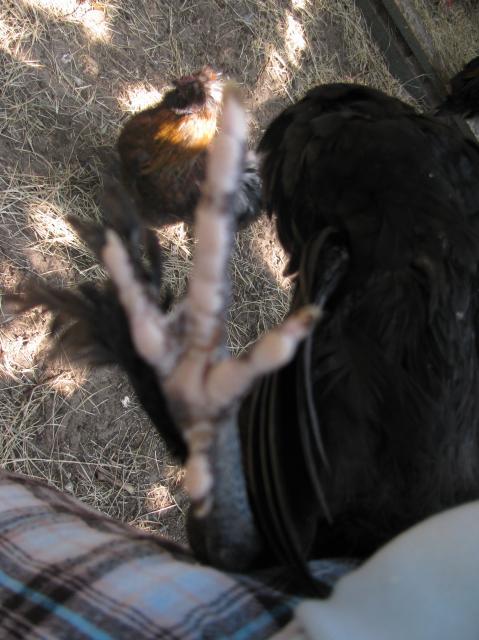
Both the L and B version of legfeathering is incompletely dominant, meaning it has a dosage affect. This is why breeding for single toe feathering can be so frustrating.






 Open Contest Favorite Breed Photo Contest - Brought to you by Valley Hatchery
 SHEPHERD APPRECIATION THREAD!!!!!!!!!!! ALL SHEPHERD BREEDS WELCOME!!!!!!!!!!
 BYC's 52-Week Photography Challenge — Week 12: Details! — Mar 23–29, 2026
 First Time Candling, I'm Not Sure If I did It Correctly

