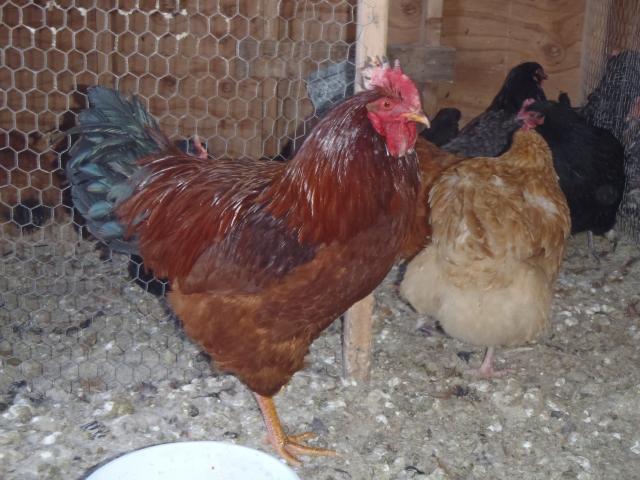
Breeding sexlink to sexlink

Fred's Hens :

(2.) a super producer. . . But for a max of about 1 year, usually less??
Hyline, I.S.A./Hendrix and other genetics companies publish the results of their egg laying and show that following a molt at 52 weeks, the second year's production to be over 300 eggs, remarkable similar to the first years production. In fact, peak egg production does not occur until week 90, which is toward the end of the second year.
http://www.hyline.com/userdocs/Hy-LineBrown.pdf

A sex-link may or may not be someone's cup of tea, but one needs to exercise some caution about making statements as fact that may merely be oft-repeated myths that may not have basis in fact.

Best Regards,

thumbsup.gif
 
Fred's Hens :

Quote:
Do you have data for these positions?
(1.) MORE risk of eggbound, internal laying short lifespan, etc??
On what do you base this risk? What references can you provide for this?

(2.) a super producer. . . But for a max of about 1 year, usually less??
Hyline, I.S.A./Hendrix and other genetics companies publish the results of their egg laying and show that following a molt at 52 weeks, the second year's production to be over 300 eggs, remarkable similar to the first years production. In fact, peak egg production does not occur until week 90, which is toward the end of the second year.
http://www.hyline.com/userdocs/Hy-LineBrown.pdf

A sex-link may or may not be someone's cup of tea, but one needs to exercise some caution about making statements as fact that may merely be oft-repeated myths that may not have basis in fact.

Best Regards,

This is amazing data and will probably be educational to many.
thumbsup.gif
 
Last edited:
Quote:
This roosters father was a New Hampshire and mother a Black Sexlink: https://www.backyardchickens.com/forum/uploads/71540_ryans_olympus_camera_pictures_019.jpg
Here is his son, his mother was a Red Sexlink:https://www.backyardchickens.com/forum/uploads/71540_febuary_32011_059.jpg
I have others but its a blizzard outside right now so not the ideal time to take pictures.

thanks very much ryan. nice looking offspring and parents! if your snowstorm ever ends and you feel like taking some more, you know where you can dump em off!
wink.png
 
Last edited:
Quote:
I agree that breeding Sexlink to Sexlink shouldnt dramatically drop production of their offspring, though I have never really heard much of an argument against this idea. It seems like where the confusion comes in is the whole deal that Sexlink X Sexlink does not equal Sexlink.

But I plan to start a flock of Golden Commets mainly for layers and keep Golden Commet roos with them and hatch some to sell locally during the spring time but I'm not really basing the choice on the productivity an such but just mainly that I should get about 4 different color variations from breeding them together.

glad to hear you are going to do this, clint. please keep me/us posted on your results. thanks for the input.
 
okay im new at this....... i have a question i ordered some chickens from mcmurray hatchery and they sent me 8 male red star sex link chickens what can i breed them with to keep the sex link thing going please someone help me:)
 
Sex Link chickens can be created by using two Purebred chickens of certain breeds. Sex Link refers to the color of the down of the chicks when they hatch.

The Sex Link trait is used so the male and female chicks can be separated at hatch time.

You do not need several lines of chickens to produce the sex link effect.
 
Quote:
Nothing, those chickens are a specific mutt that allows them to be sexed at birth, but because they are mutts their chicks cannot be sexed at birth.
 
IMBDEA, this only partially refers to your all male situation, i realize.......................


Many members of BYC either:

1. allow mutts to be created in their 'pure bred' flock;

or,

2. deliberately create 'mutts' in their flock, by allowing 'pure breds' to interbreed. These same people of 1. and 2. often keep these 'mutts'and love them.

Almost all breeds of chickens are in fact 'mutts'. The only difference between 'mutts' and 'pure breds' is that the 'pure breds' have had certain body shapes, feather colors, etc. bred out of them. This was done more or less long ago by certain individuals who wanted to create a 'specific-looking' bird.

So let us be specific: almost every 'pure breed' of poultry is a 'former mutt now purified', a 'former mutt now fixed'. In other words they are still 'mutts', but considered 'under a certain aspect'


NOW about your Murray McMurray 'mutts': this put-down term might be left aside for the more precise term, 'hybrid'. Your red sex links are hybrids between a Rhode Island Red male and (most likely) a Delaware female or (less likely) a White Rock non-silver-factor female. Put in a constructive and not belittling way, your babies are part RIR and part DEL (most likely). That's it.

Now, regarding all non 'pure breed' or 'hybrid chickens: These also most definitely--most definitely--can become future 'pure breds' if you or anyone else, with a specific goal in mind, set about to breed them and select for certain traits which were desired. This is just how todays 'former mutts now purified' came to be.

So today's 'pure breds' are mutts under a certain aspect: 'former mutts now purified'
And today's 'mutts' could be truly called--if one were willing to persevere in breeding--'pure bred' birds, but under a certain aspect: 'pure breds in the making' or 'pure breds of tomorrow'

Enjoy your lovely Murray McMurray hybrids. Every one of us keep mutts, whether we want to admit or not. and they are valuable.
 
Last edited:
One can use most any starting stock to begin a breeding program. Careful selection of the traits and features that one finds desirable.
The "trick" however, is to stabilize the offspring, achieving consistent offspring according to the breeders desired traits.

It isn't easy to do. Even today, a "sport" or non-typical offspring appears. In fact, producing consistent, almost predictable offspring is the minority not the majority of offspring. The gene pool of the parent stock is large. Whether one is breeding beagles, as I have, or chickens, one has to have skill, patience, knowledge and a lot of luck. Out of two litters of 6 pups each, maybe, maybe one pup would be so sharp, that I would keep it. The rest were fine, fine dogs, but not consistent with what I was going for.
 

New posts New threads Active threads

Back
Top Bottom