Quote:
Actually lack of black ticking is a defect and points taken off for it not a DQ so they can still be shown.
The males are off in color as well as the females.
For one thing the hackle is what old timers used to call "yellow neck" and it was not because they were right.
The ground color of the females and the breast of the males is too dark.
Remember this is to be a dual purpose breed and was at one time the premier breed for broilers so they had to dress clean.
I recommend that you go to your library and check out the APA Standard of Perfection in color and look at the pictures.
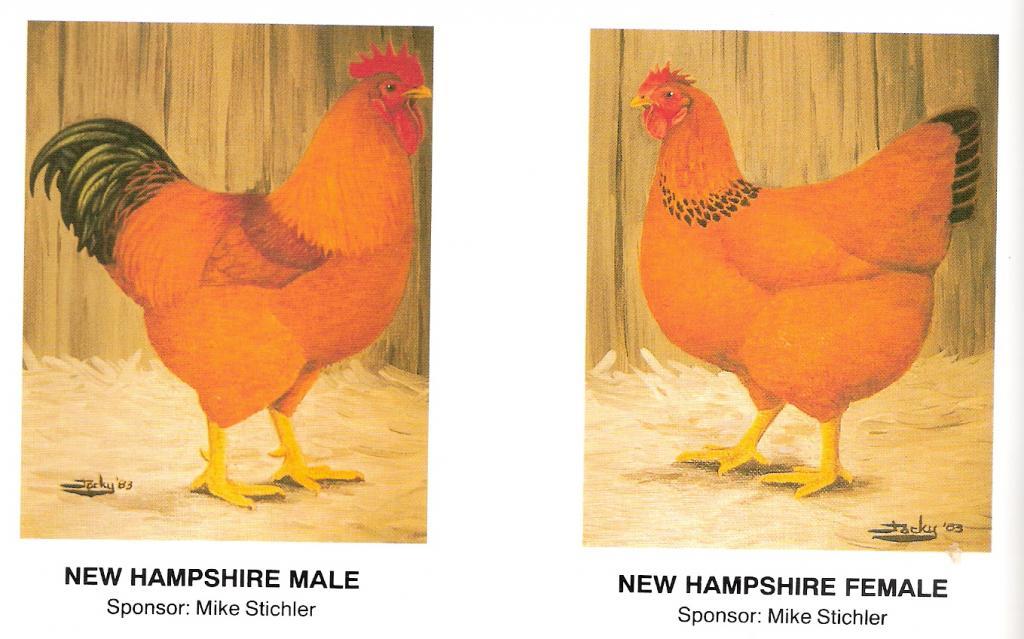
I had Dianne Jackie redo the pictures because the color was wrong.
After 30 years of breeding the New Hampshire bantams I know a little about New Hampshires.
Thank you for weighing in on that. I thought the same thing, regarding a defect rather than "they can't be shown." But then I though maybe Matt1616 said this because he knew otherwise.
Are you saying the artist's rendition of color in the new SOP is accurate for the New Hampshire? I have the latest edition and it looks totally orange to me, with very little variation..... hardly noticeable at all actually. (Frankly, I think the pictures are awful. But, then again, I don't like any of Jackey's chicken art.) YET, the description uses many colors to describe the beautiful New Hampshire chicken:
MALE
HEAD: Plumage, Brilliant reddish bay.
NECK: Hackle-- lustrous, golden bay.
BACK: Brilliant deep chestnut red.
Saddle -- lustrous, golden bay, slightly darker than hackle.
TAIL: Main Tail -- black
Sickles -- rich, lustrous, greenish black.
Coverts -- lustrous, greenish black, edged with deep chestnut red.
Lesser Coverts -- deep chestnut red.
WINGS: Fronts -- medium chestnut red.
Bows-- brilliant deep chestnut red.
Coverts -- deep chestnut red.
Primaries -- upper web, medium red, lower web, black edged with medium red. Primary coverts, black, edged with medium red.
Secondaries -- upper web, medium chestnut red, having broad black stripe extending along shaft to within one inch of tip; lower web medium chestnut red; shaft, red.
BREAST: Medium chestnut red.
BODY AND FLUFF: Medium chestnut red.
LEGS AND TOES: Lower Thighs-- medium chestnut red.
Shanks and toes-- rich yellow tinged with reddish horn. A line of reddish pigment down sides of shanks extending to tips of toes is desirable.
UNDERCOLOR OF ALL SECTIONS: Light salmon.
FEMALE
HEAD: Plumage, medium chestnut color.
NECK: Medium chestnut red. each feather edged with brilliant chestnut red; lower neck feathers distinctly tipped with black.
Front of neck -- medium chestnut red.
BACK: Medium chestnut red.
TAIL: Main Tail -- black, edged with medium chestnut red; shaft medium chestnut red.
WINGS: Fronts, Bows, and Coverts -- medium chestnut red.
Primaries -- upper web, medium red; lower web, medium red with a narrow stripe of black extending along the shaft; shaft, medium red.
Primary Coverts -- black, edged with medium red.
Secondaries -- lower web, medium chestnut red with black marking extending along edge of shaft two-thirds its length.
BREAST: Medium chestnut red.
BODY AND FLUFF: Medium chestnut red.
LEGS AND TOES: Lower Thighs -- medium chestnut red.
Shanks and toes -- rich yellow tinged with reddish horn.
UNDERCOLOR OF ALL SECTIONS: Light salmon.





 Open Contest BYC Poultry Caption Contest 02-27-26 Pic by Ponypoor
 Here they come, just-a rockin' in the heat...
 Open Contest BYC Pets & Livestock Caption Contest 02-27-26 Pic by drstratton
 BYC Member Interview - FunClucks
 Question of the Day - Friday, February 13th, 2026
 BYC's 52-week Photography Challenge. Week 8: (Feb 23-March 2, 2026) Theme: Signs