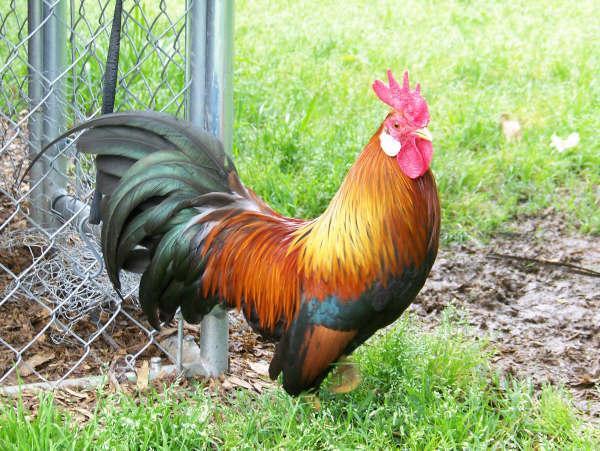
A good rule to look for that works in most cases is this: if the bird has rich color patches in the shoulder area at or younger than about 4 months old, it is usually male, while if it is patterned evenly overall, it is female. This depends on the color and breed, of course. Typically, the color on a pullet is not as vibrant as that of a cockerel, either. Take for example the light brown Leghorn. The rooster has a very vibrant pattern, but it is concentrated to the hackles, shoulders, and saddle area:
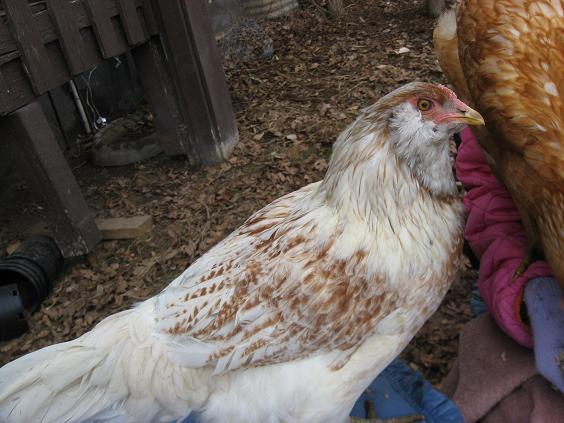
The hen, such as my dear Whiri here, has a less vibrant coloration that is spread more uniformly than the rooster:
Some mixes become trickier, especially Easter-eggers. See how the below bird has red in its shoulders? This, however, is a hen. The red is not as rich and is spread out, not concentrated in patches as it would be in a young cockerel.
Now on my young Easter-egger cockerel, Hika Ma, while he was obviously male, he did not get the bright red shoulder patches. However, if you look closely, you can see that he has patches of white in his shoulders instead, presumably because he carries two copies of the silver gene:
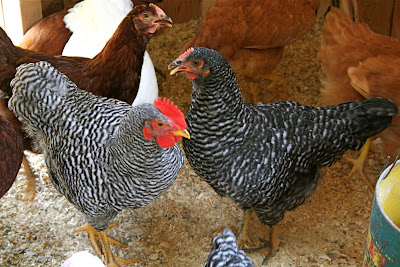
You also don't see red shoulders in birds like Barred Plymouth Rocks or Dominiques, but they can be easily sexed visually if they are pure bred because of the differences between the sexes. The hens, carrying only one copy of the barring gene, are darker barred or have thicker black bars than white. The males, carrying two barring genes, are lighter, or have wider white bars than black. However, since mixes between barred or cuckoo breeds and other breeds often result in roosters with one copy of the barring gene, this is not reliable unless you can confirm that the bird is pure bred.
Typically also, unless it is a black bird like an Australorp, a hen will not have a black chest. That is how I was certain that Whiri was a pullet from pretty early on, even though she had a big comb. Her chest was rosy brown, not black like a Light Brown / Partridge cockerel's chest would have been.
There are many other rules, but I feel like nothing can really be said with absolute certainty. In general, however, the above holds true to sexing birds by their appearances. I hope that answers your questions.

(P.S., all of the pictures besides Whiri and Hika Ma were found on Google and are not my birds.

)
ETA: This was in response to racinchickens, of course.