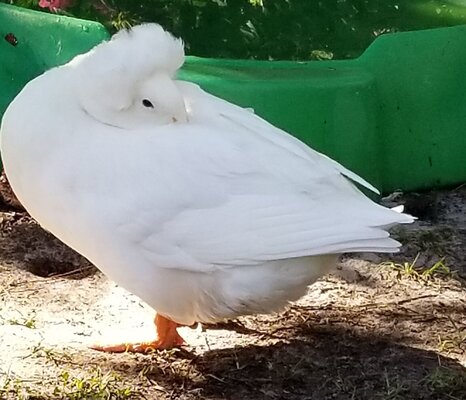
The tuft of feathers is unrelated to the hatching. Its called a crest and is a genetic mutation -- probably spontaneous in your little fluffy. Generally there is a defect in the midline of the skull where the two sides meet and fuse developmentally. The size of the tuft indicates yours likely has a small defect [or perhaps no defect]. there is generally a lipoma, a small fatty lump, over any defect in the skull. There can be other midline defects -- for example in the spine --associated.
While there is an increased risk of neurological defects, particularly in those with the largest crests and hence largest defects, most crested ducks lead normal happy lives. A female's crest needs to be protected from aggressive mating as the drake may pull on the tuft of feathers rather than the feathers on the back of her neck.
My son's female crested is a little smaller than his female pekins. She also has a spontaneous genetic mutation and an associated "kink" in her neck spine which is only visible when her neck is outstretched downwards [standing on the side of her kiddie pool drinking, for example.] She is the cutest, liveliest, loudest and most intelligent of all my son's ducks. The photos are of her -- Mop Head as she is affectionately known.
Some people intentionally breed crested ducks, as they look cute. The problem is that there is a high problem of ducklings with genetic defect that is incompatible with life when a crested drake and a crested female are mated. Twentyfive percent of the fertilized eggs will have embryos develop that are not compatible with life, and die in the shell. Many people find it unacceptable to intentionally breed ducks with such a high mortality.
I have a crested pekin drake -- he is in an all male flock and so will not pass on his defect. My son's crested pekin female is in an all female flock in a different neighborhood from mine. There is zero chance that they will breed!