Quote:
I haven't seen any DQ'ed for leg color, earlobe color, etc. YET, but it's coming. It may just be individual judges that choose to overlook the fault at shows I've been to. Comb shape has been a big deal, though. No side sprigs or inverted combs allowed.
Judges are likely the issue. My kids showed at a show with a black hen that had blueish green legs and they were told it was a defect. Guess this is really a question for Jerry. As for the comb I know on all sites regarding Seramas combs are a HUGE deal. Especially with the 5 distinct points. Here is what Jerry gave me when we bought our birds from him. Hope it helps some that have questions.
Standards and Judging
AMERICAN SERAMA TYPE STANDARD
(As it appears in the SCNA Website)
SCNA WEIGHT STANDARD adopted 5/24/08
The Serama Council of North America (SCNA) Standard of Perfection calls
for the following acceptable weights based on our pending ABA proposal for acceptance.
Cocks 16 ounces with a 20% variable either way, or
12.8 to 19.2 oz (358-537 gm), without disqualification
Hens - 14 ounces with a 20% variable either way, or
11.3 to 16.8 oz (313-470 gm), without disqualification
Cockerels - 14 ounces with a 20% variable either way, or
11.2 to 16.8 oz (313-470 gm), without disqualification
Pullets - 12 ounces with a 20% variable either way, or
9.6 to 14.4 oz (368 to 403 gm), without disqualification
Serama would be entered either as a Cock, Hen, Cockerel, or Pullet, at all combined ABA/APA sanctioned
(In-Cage Judging) Shows and SCNA Tabletop Shows.
SCNA, Stand-Alone (Tabletop) Shows, will observe the A, B & C classifications for both Cocks and Hens, along with a Cockerel and a Pullet Class. Acceptable weights will be as taken with no weight variation.
SIZE CLASSES:
1) MATURE CATEGORY:
Cocks
A - up to 13 oz (350 gm)
B - up to 16 oz (500 gm)
C - up to 19 oz (600 gm)
Hens
A - up to 11 oz (325 gm)
B - up to 14 oz (425 gm)
C - up to 17 ounces (525 gm)
2) YOUNGSTERS:
Cockerels One Class Only
Up to 16 oz (500 gm)
Pullets One Class Only
Up to 14 ounces (425 gm)
Shape of the Male
Comb: Single, medium, set firmly and evenly on head, straight and upright, evenly serrated with five regular and distinct points, the middle points the same length as the width of the blade, moderately arched, blade should extend well over back of head.
Beak: Strong, stout and well curved.
Face: Small, rounded, smooth, fine in texture, free from wrinkle or folds.
Eyes: Round, conspicuous.
Wattles: Medium, round, fine in texture, free from wrinkles or folds.
Ear Lobes: Small, oval, fitting closely to the head.
Head: Small, carried well back in a proud manner.
Neck: Medium length, backward arched, showing off breast, full, tapering gracefully from shoulders to head.
Hackle: Abundant, flowing naturally from front of neck reaching far back covering both shoulders.
Back: Short, broad, in profile, shaped like a 'V' with neck and tail forming the vertical sides.
Tail Coverts & Saddle: Slightly curved, sword shaped hanging over the abdomen and covering back, widely spread, overlapping the tail and lesser sickles.
Tail: Moderately large and upright, carried in an upright position so as to almost contact the back of head.
Main Tail: Feathers wide, moderately spread in a neatly overlapping manner, rising above the head, A shaped from the rear view.
Main Sickles: Medium to long, strong, firm, broad sword-shaped slightly curved.
Lesser Sickles: Well-spread, medium length slightly upright, sword-shaped sickle feathers covered with coverts.
Coverts: Abundant, becoming very broad, flowing well up tail.
Wings: Large, long, closely folded, carried vertically not quite touching the ground, Shoulders and Fronts: Prominent, slightly concealed by hackle.
Bows: Well rounded.
Coverts: Feathers broad, forming two distinct bars across wings.
Primaries: Moderate width, rather long, completely concealed by secondaries.
Secondaries: Broad, tapering convexly to rear, wing bay well exposed.
Breast: Highly lifted, well developed, full, carried prominently forward beyond the vertical line drawn from point of beak, broad and well rounded, from head to neck to breast S shaped profile.
Body & Stern: Body- short, good depth and width, sloping from front to rear. Stern: Fluff, short, abundant.
Legs & Toes: Legs- average length, widely set, parallel to each other without bowing or knocked knees, well proportioned.
Lower Thighs: Medium, stout at top and tapering to hocks.
Shanks: Medium, smooth, round, evenly scaled.
Toes: Four, straight, well and evenly spread, evenly scaled.
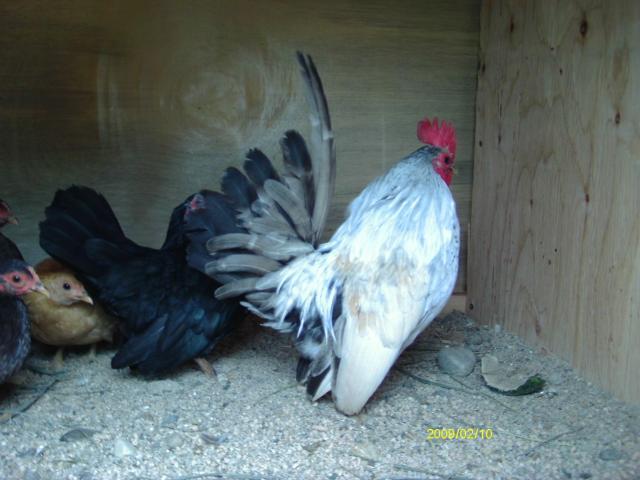
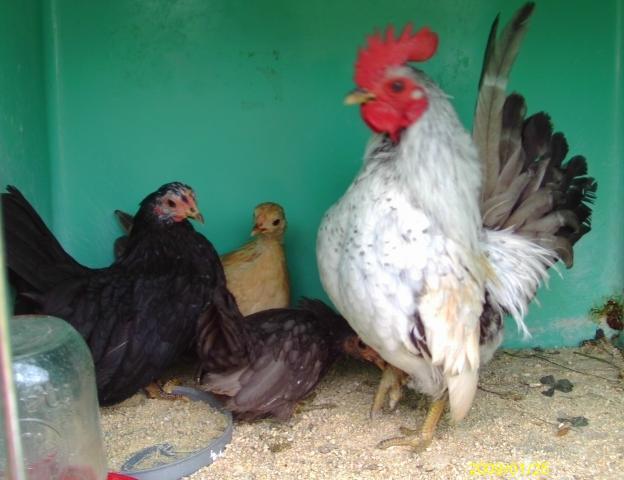
Appearance: Small, broad, compact, active, tame, standing up majestically.
Shape of the Female
Comb: Single, small, set firmly and evenly on the head, straight and upright, evenly serrated with five regular and distinct points, the middle points the same length as the width of the blade, moderately arched, blade should extend well over the back of the head.
Beak: Strong, stout, and well curved.
Face: Small, rounded, smooth, fine in texture, free from wrinkle or folds.
Eyes: Round, conspicuous.
Wattles: Small, round, fine in texture, free from wrinkles or folds.
Ear Lobes: Small, oval, fitting closely to head.
Head: Small, carried well back in proud manner.
Neck: Medium length, backward arched showing off breast, full, tapering gracefully from shoulders to head.
Hackle: Abundant, flowing naturally from front of neck reaching far back covering both shoulders.
Back: Short, broad, in profile, shaped like a V with neck and tail forming the vertical sides.
Cushion: Short, feathers broad and plentiful.
Tail: Moderately large and upright, carried in an upright position so as to almost contact the back of head.
Main Tail: Feathers wide, moderately spread in a neatly overlapping manner, rising above the head, A shaped from the rear view.
Coverts: Abundant, becoming very broad, flowing well up tail.
Wings: Large, long, closely folded, carried vertically not quite touching the ground, Shoulders and Fronts: Prominent, slightly concealed by hackle.
Bows: Well rounded.
Coverts: Feathers broad, forming two distinct bars across wings.
Primaries: Moderate width, rather long, completely concealed by secondaries.
Secondaries: Broad, tapering convexly to rear, wing bay well exposed.
Breast: Highly lifted, well developed, full, carried prominently forward beyond vertical line drawn from point of beak, broad and well rounded, from head to neck to breast S shaped profile.
Body & Stern: Body- short, good depth and width, sloping from front to rear. Stern: Fluff, short, abundant.
Legs & Toes: Legs- average length -- widely set, parallel to each other without bowing or knock ed knees, well proportioned.
Lower Thighs: Medium, stout at top and tapering to hocks.
Shanks: Medium, smooth, round, evenly scaled.
Toes: Four, straight, well and evenly spread, evenly scaled.
Appearance: Small, broad, compact, active, tame, standing up majestically