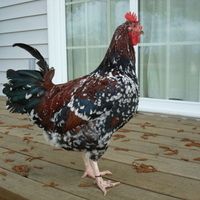
OK Karen, let's talk about this. . . Let me pick your mind for a few moments, please.
First off, would share the recipe for the special diet you are feeding your Sussex.
Hi Lisa,
I wish I could. The only Sussex I have had so far have been utitlity Speckel Sussex I got after they had finished growing as pullts, cockerel, hens and rooster. So while I learned about breed maintinance, but not growing up the birds. Have studied a lot of the oder texts and talke dto breedrs about the topic, tho. As far as growing out chicks, my experience is with Marans. A true beleiver in the imprtance of the health and proper functioning of the GI tract in the proper development of young mammals and birds, I fed them Poultry Nutri-Drops from birth on in their water. Have had no complaints and some nice compliments on the size and health of the Marans I gave away during my time in the breed.
Unless I can get the formula from the breeder from whom I am getting my Light Sussex, I will have to formulate one of my own.
Second, I am concerned with the "fattening" of the birds. I've read in many places where fat birds don't lay as well . This aspect is important to me. We don't eat too many of our birds, but we do eat their eggs.
There's a difference between a fat bird and a bird bred for fattening and the fattening of the bird itself.
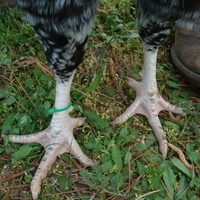
A fat bird which doesn't lay well often carrys a layer of fat underneath the skin. One indicator if a bird may fatten like this is the texture of the bird's skin. A bird with fine texture of skin has skin which will stretch when the bird comes into lay...giving room for the expansion of the bodily organs which increase in size when the bird starts to lay. a bird with coarse skin has skin which doesn't stretch as welll at all. This bird tends to instead develop a layer of non-stretchable fat underneath the skin. Because the bodily organs doesn't have as much room to expand, the bird isn't as good a layer. Note the Sussex SOP states skin of a "fine " texture. The quality of the skin on a bird's legs is one indicatior of the type of skin on the rest of the bird. Note the Sussex SOP states the scales /skin on the legs is of "fine" textrure.
A bird bred for fattening has a structure built to handle the increased weight of the meat put on the carcass when the birds are fattened. In fact, the Sussex Standard states the bones should be fine. Not weak, just fine ( not coarse). The Sussex has well built legs placed properly underneath it so it can handle the weight of it's carcass. The birds were only crammed for a period of 3 weeks before slaughter so no need to carry this extra weight for months. Plus they were not allowed room to roam in the cramming cages. That would defeat the fine white, tender flesh which resulted from cramming the birds with the Sussex oats and skim milk recipe.
Because the structure of the birds relates to every aspect of their commercial virtues, Breed type is everything in Sussex. If it doesn't look like a Sussex, it's
not a Sussex ,regardless of color. Color is
always last with Sussex.
A Sussex which is not fattened for market, properly bred, still carries all the breed virtues necessary for it to also be a fine layer. One one half of this breed was bred for the cramming, the cockerels. The hens were bred to be fine winter layers so the chicks could be raised early and the cockerels crammed for Derby Day. That's the neat thing about the Sussex. Properly bred over 2 cnturies, they are about a perfect balance betwene the egg and the meat breeds. Able to function as either or both ends of the specturm without outcrossing or modifying breed type.
best,
karen
Would you share the website for the British breeder? I would like to find out more about the award.
http://www.brooklandwhite.co.uk/sussex_fowl.htm
While we are on the topic of feed and making birds bigger, have you noticed that the SS seem to be late bloomers? I've got some 10 month old hens that seem to be finally getting big. My other two breeds are large fowl - Delaware and Marans. I have always been disappointed in how small the SS are. They have the same weight standard as the other Sussex and yet, mine seem so small. They are small compared to my Marans and Delawares too. I am waiting to see if these girls are just late bloomers, really late bloomers, and won't put the size on until they are 1 year old. Karen what have your experiences with the SS been when it comes to development? Do they mature at the same rate as the other Sussex? Do they mature as quickly as the Delawares or Marans?