

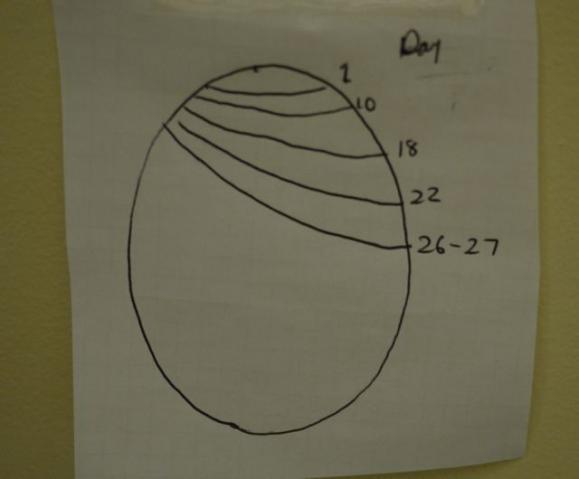
Here is the diagram I have used to monitor air cell development. I traced it from D. Holderread (1978) "Raising the Home Duck Flock". I put it on the wall by the incubator so it was handy when I candled the eggs. The numbers represent days into the incubation period.

For temperature in a still air incubator, Holderread's "Storey's Guide to Raising Ducks" says to raise the temp a bit each week. He advises 101.5F for the first week, 102F for the second week, 102.5F for the third week and 103F for the last week, If you want to keep it the one temp the whole way through (e.g. because you want to add eggs each week) he says 102F to 102.5F. The temperature must be measured level with the top of the egg but he advises against laying the thermometer on the eggs to measure the temp as this will give an artificially high reading. Instead, measure at a point about 2 inches above the bottom of the egg tray.
Stillmecle, a cat-proof environment with low temperature fluctuation and decent ventilation is indeed what you are after.... Can you move the dresser so the cats can't jump on it?
For temperature in a still air incubator, Holderread's "Storey's Guide to Raising Ducks" says to raise the temp a bit each week. He advises 101.5F for the first week, 102F for the second week, 102.5F for the third week and 103F for the last week, If you want to keep it the one temp the whole way through (e.g. because you want to add eggs each week) he says 102F to 102.5F. The temperature must be measured level with the top of the egg but he advises against laying the thermometer on the eggs to measure the temp as this will give an artificially high reading. Instead, measure at a point about 2 inches above the bottom of the egg tray.
Stillmecle, a cat-proof environment with low temperature fluctuation and decent ventilation is indeed what you are after.... Can you move the dresser so the cats can't jump on it?


