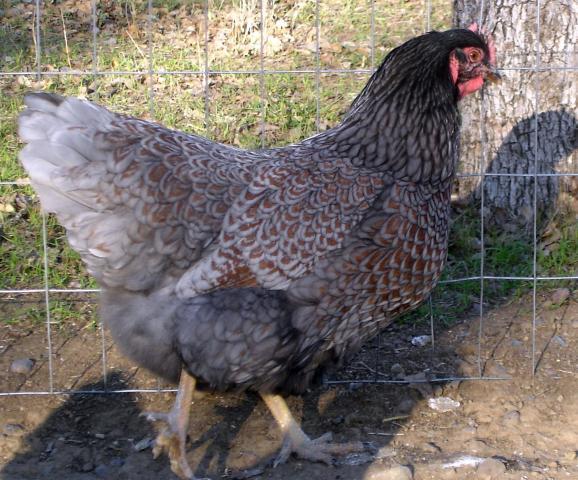
Barnevelder breeders lets work together and improve the breed

Quote:
I had the same issue. I started them on their side, then after a few days it was evident. Also, I have noticed with other eggs that usually the dark is on the fat end... no promises...
 
wood&feathers :

You say you rescued him? The purple at the tips may be a result of poor nutrition or illness for a period. Kind of like we get ridges in our fingernails after getting sick. It might not be genetic at all.

HI, Thanks everyone.Really Appreciate....He was a hatchling from eggs i received....The siblings are nicely laced. He just finished first molt and his tail feathers half grown in but the last 3 plus inches are black with lavender sheen. No illness but it has been real cold then fall like...feed normal, wormed last month, free range in rotation with other pens....i did change to feed from a local mill recently....Maybe i will go back to the old feed in that pen for a few months and see how it all goes???? sorry no pics, (problem with puter)...eliz​
 
Quote:
Hey Girl!!!!!
frow.gif
How you doing? Hope you are doing great!
Sorry I haven't responded to your email yet...I'm not ignoring you, just very busy.
smile.png
Will have time this weekend to go through emails.

Anyway....about your Barnie boy, I think you should test mate him this spring and see what he throws, I don't think that the purple sheen color you are describing is a problem, but I could be very mistaken. Maybe Trisha, Andy, Tailfeathers or Happy Chooks will respond and give their opinion too.

Does this particular roo have dark hackles and saddles?

BTW.....if you are looking for some cockerels to grow out while waiting for some pullets (
lol.png
like we are all looking for more cockerels to grow out, right? with the price of feed? Shuhhhh!
gig.gif
) I have 4 pure Johan cockerels, all under 2 mos of age, up for grabs.
big_smile.png


Hi, no worries, didn't know if you were going to the poultry show in Chehalis this weekend...am going sat. for a few hours....
ya.gif
Yes this boy has dark hackles and saddle. eliz
 
Quote:
Thanks, I will give it a try that way. Figured I would put a few in and see if the Rooster was doing his job.

If you have an extra egg from your Barnies that you could spare, you could always crack it open and look for the little bullseye to see if your boy is doing his job.
smile.png
 
Quote:
Hey Girl!!!!!
frow.gif
How you doing? Hope you are doing great!
Sorry I haven't responded to your email yet...I'm not ignoring you, just very busy.
smile.png
Will have time this weekend to go through emails.

Anyway....about your Barnie boy, I think you should test mate him this spring and see what he throws, I don't think that the purple sheen color you are describing is a problem, but I could be very mistaken. Maybe Trisha, Andy, Tailfeathers or Happy Chooks will respond and give their opinion too.

Does this particular roo have dark hackles and saddles?

BTW.....if you are looking for some cockerels to grow out while waiting for some pullets (
lol.png
like we are all looking for more cockerels to grow out, right? with the price of feed? Shuhhhh!
gig.gif
) I have 4 pure Johan cockerels, all under 2 mos of age, up for grabs.
big_smile.png


Hi, no worries, didn't know if you were going to the poultry show in Chehalis this weekend...am going sat. for a few hours....
ya.gif
Yes this boy has dark hackles and saddle. eliz

No, not going up to the show, just don't have the time. Lots to do around here with the chooks and the weather is going to be beautiful this weekend so I gotta jump on it.
smile.png


So the sheen is lavender or it's dark dark purpleish?
 
Quote:
Thanks, I will give it a try that way. Figured I would put a few in and see if the Rooster was doing his job.

If you have an extra egg from your Barnies that you could spare, you could always crack it open and look for the little bullseye to see if your boy is doing his job.
smile.png


I have occasionally and it is hit or miss...he has a lot of girls right now as he is the only rooster at the moment (had to get rid of an agressive rooster earlier this year). Thought I would put a few in and see what happens since I was incubating some others at the moment. I have seen the photos on BYC to determine fertile and infertile eggs and they have been quite helpful. love the site and all the help I get from everyone here.
 
Quote:
If you have an extra egg from your Barnies that you could spare, you could always crack it open and look for the little bullseye to see if your boy is doing his job.
smile.png


I have occasionally and it is hit or miss...he has a lot of girls right now as he is the only rooster at the moment (had to get rid of an agressive rooster earlier this year). Thought I would put a few in and see what happens since I was incubating some others at the moment. I have seen the photos on BYC to determine fertile and infertile eggs and they have been quite helpful. love the site and all the help I get from everyone here.

Yep...this BYC place ROCKS!!!!!!!!!!! I love BYC and all it's FABULOUS chicken folks!!!!!!
love.gif
 
Regarding the purple sheen...... scroll down to bolded content.


from http://sellers.kippenjungle.nl/page2.html#t12


Genetics of feather color:

The genetics of feather color and patterns is an active topic of poultry science research. Much of the work that was done prior to the late 1980s is now considered out of date. Because a number of genes interact to determine feather colors and patterns, it might seem to be too involved for the average enthusiast. I don’t believe that this is the case, however, the topic of feather color and patterns may be beyond the interest and motivation of some enthusiasts.

White is actually all the colors combined and black is the lack of reflection of light in the visible range, so one might argue that black and white are not really ‘colors’ technically. However, if we count black and white as colors, chickens have only three basic colors: black, white and red (gold).

The colors of chickens are achieved by diluting and enhancing or masking black and red (gold). For example, Rhode Island Reds have the gold gene with the dominant mahogany (red enhancing) gene. A blue chicken is a black bird that has the blue gene which dilutes black. Two copies of the blue gene give a splash effect. A white chicken can be achieved in a number of ways by inhibiting black and red pigmentation with combinations of genes (dominant white, recessive white, silver, Columbian, Cuckoo barring).

Some perceived colors of feathers are due to the structure of the feather and not any pigmentation. The purple and the ‘beetle’ green sheen that can be seen in some poultry is due to the way the feather structure reflects light rather than the presence of a pigment.

First, we need to define a couple of terms. In poultry there are primary and secondary color patterns. Perhaps it is better to define secondary patterns first. A secondary pattern is a pattern that appears on individual feathers. These are patterns like single and double lace, mottle, and so on. Primary patterns are color patterns that involve the entire body of the bird. An example is the silver Columbian pattern. In the Columbian bird, black is restricted to the hackles, wing bow and tail. The silver Columbian is a white bird with some black in the neck, wing and tail areas. Because this pattern is not manifest on individual feathers, it is a primary pattern.

To ‘construct’ a chicken having a particular color scheme, one begins with the ‘background’ or the E-locus gene(s). The other color and (secondary) pattern genes essentially modify this ‘background’. Please refer to the table at the end and the pattern table below to see the choices and comments (other E-genes have been proposed but they are not yet well accepted). Some of these are: E, extended black or nigrum; ER, birchen; eWh, dominant wheaten; e+, wild type; brown, eb; speckled, es; buttercup, ebc; and ey, recessive wheaten. These genes cause recognizable chick down color and influence the adult feather color, sometimes male and female feather colors are influenced differently. For photographs of chicks with an assortment of E-genes the interested reader is directed to Poultry Breeding and Genetics, R.D. Crawford, ed., Elsevier, 1990 pages 115-117.

As an elementary exercise, let’s ‘build’ a white chicken. We can start with wild-type background, e+, and require our bird to have two copies of this gene. We can suppress the red in the chicken by adding the silver gene, S, which has the effect of changing red to white. Black is suppressed (changed to white) by the dominant white gene, I, however this gene is ‘leaky’ (see the table for comments) and allows black specks through. A good ‘helper’ gene in this situation is the Columbian gene, Co, since it is a restrictor of black. Although this set of genes is not the only set that will yield a white chicken, it is one of the ways a white chicken can be obtained.

Please see the table of chicken genes (Part III) for more comments about plumage color genes.
 
Quote:
Thank you Trisha....but look at that hunk a hunk a burning love boy you have there!!!!
love.gif
Me likey likey him!
droolin.gif


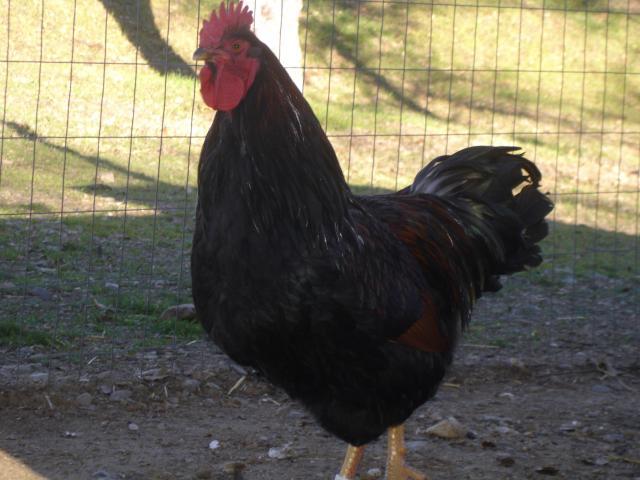
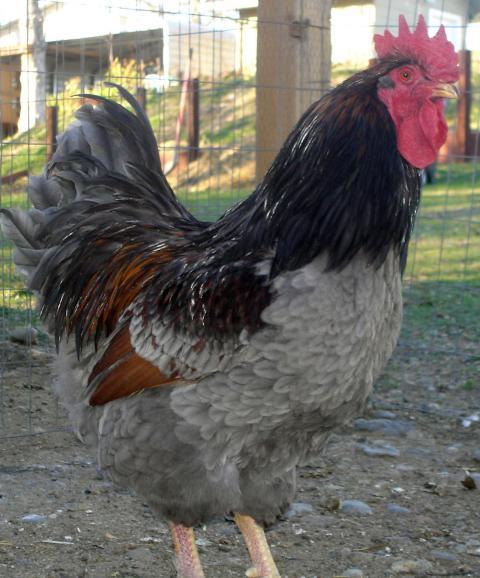
Thanks:) I'll soon be down to just 3 roos because my sister is going to "foster" my older roo (vB/Johan) for awhile. He doesn't get along with the other roos. He will be happier with his own girls (at my sis's) rather than being locked up while I'm working with projects. I'll have my blue cockerel, my Barnevelder cockerel (3/4 vB/1/4 Johan) and a project cornevelder cockerel that just missed being culled.

Speaking of "tanks" the cornevelder cockerel quite a hunk too, but needs work in his tail area (a little pinched and some white fluff) and a bit long in the back. He does have the most awesome lacing, leg color and size. He also hatched from one of the darkest, speckled egg I've gotten with tons of gloss. Sorry for the poor picture
he.gif
He doesn't like to be "singled out" for pics and was trying to hide. He's a month younger than my other roo and is still growing.
30473_cornevedler_cockerel_2012.jpg


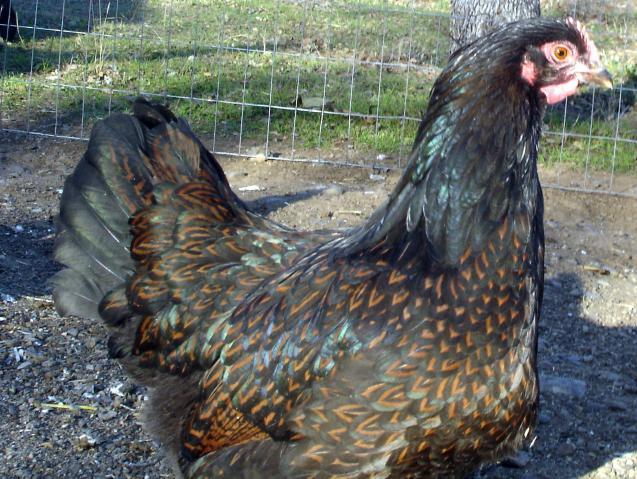
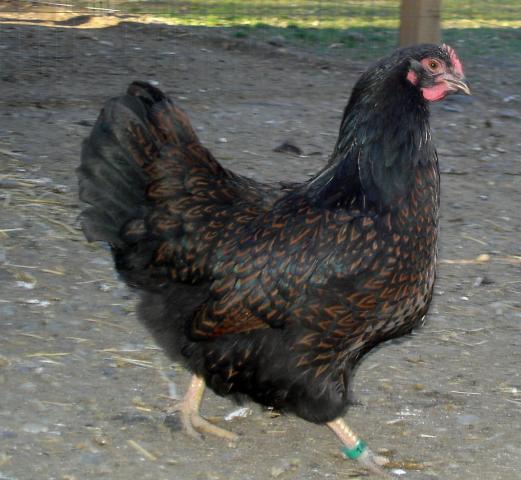
I think I may cross him with this pullet or her mother (my best hen) of course after I get some blue chicks first
fl.gif
She's one of the best so far this year. Hopefully I'll get some nice chicks from both crosses.
30473_best_barnie_pullet_3_2012.jpg

30473_best_barnie_pullet_2_2012.jpg


First I'm hoping to get some chicks from this guy by the first week in Jan....then work on the other projects.
30473_blue_cockerel_2012_2.jpg

30473_blue_pullet_2012.jpg
 

New posts New threads Active threads

Back
Top Bottom